Sep 18, 2026Mold Monitor System
Dual-Camera Mold Protection System | Injection Molding Case Study
See how a dual-camera mold protection system monitors core and cavity areas to detect remaining parts, incomplete ejection and abnormal mold conditions before mold closing.
Application Overview
In injection molding, a part that remains in the mold or an abnormal ejector condition can cause serious damage if the mold closes for the next cycle.
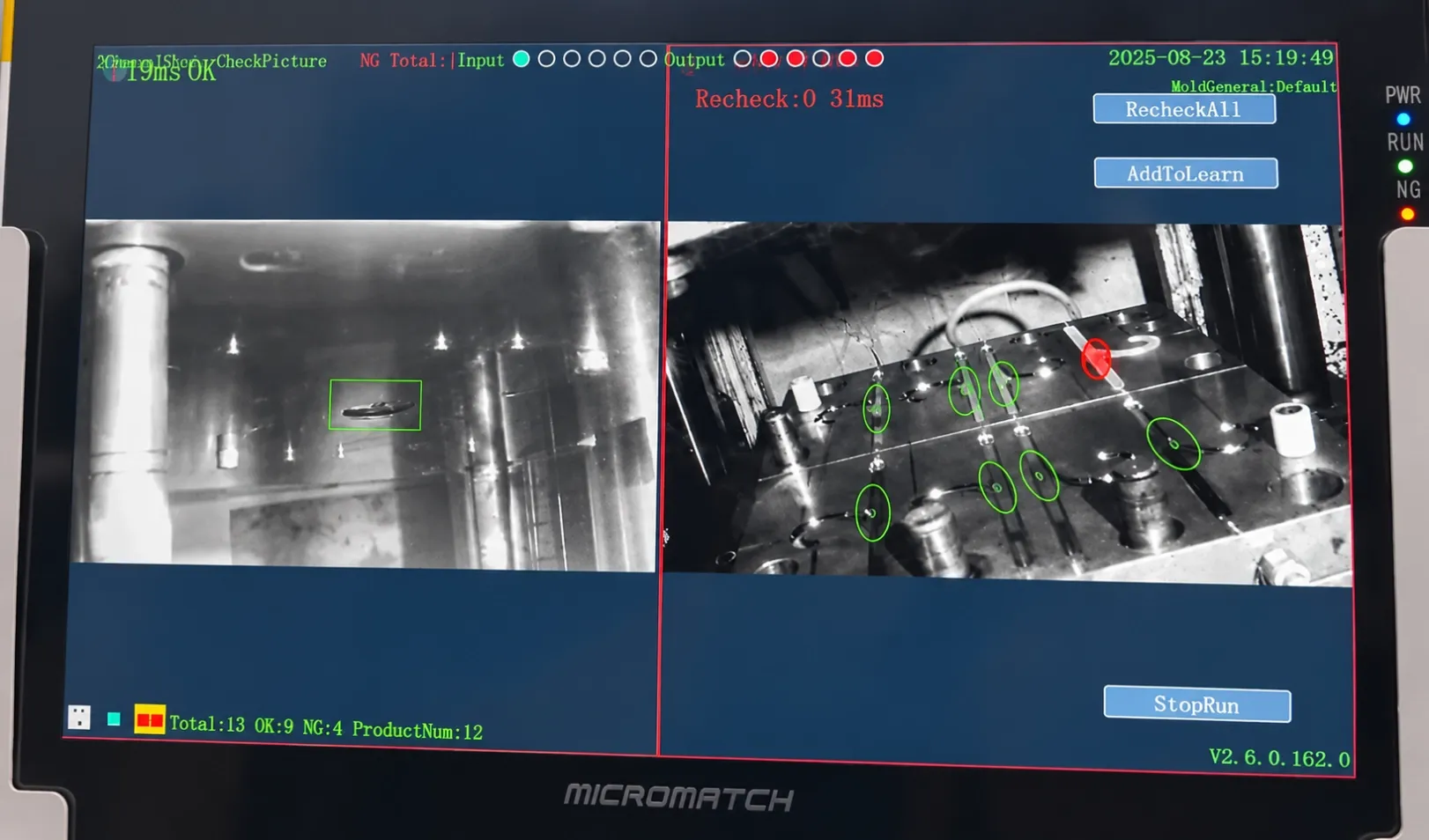
For this application, a dual-camera mold protection system is installed to monitor critical areas of the mold during the production cycle.
The Challenge
A single camera may not always provide sufficient visibility when the mold is large, deep, or when critical areas on both sides of the mold need to be monitored.
The application therefore requires two cameras to provide better coverage of the core and cavity areas.
The Solution
Two cameras are positioned to monitor the required mold areas. Inspection regions are defined according to the mold and product.
The system captures reference images during the molding cycle and compares the actual mold condition with the learned reference.
It can monitor conditions such as:
- Remaining molded parts
- Incomplete part ejection
- Abnormal ejector pins
- Inserts or components remaining in the mold
- Core and cavity abnormalities
How the Inspection Works
1. Mold opens
The system receives the inspection signal from the injection molding machine.
2. Image capture
The cameras capture the required mold areas at the configured inspection timing.
3. Vision inspection
The current images are compared with the reference condition inside the defined inspection areas.
4. OK / NG decision
If the mold condition is normal, the system outputs the required OK signal.
If an abnormal condition is detected, an alarm signal can be generated to prevent the next mold-closing cycle.
Why Use Two Cameras?
Dual-camera monitoring is particularly useful when one camera cannot clearly cover all critical areas, such as:
Large molds · Deep molds · Complex mold structures · Multiple critical inspection areas · Core and cavity monitoring
The camera configuration should therefore be selected according to the actual mold structure and required field of view rather than simply using more cameras.
Result
The system provides automatic mold-condition verification during production, helping reduce dependence on manual checking and lower the risk of mold damage caused by abnormal conditions before closing.
Have a Similar Application?
Every mold is different.
Send us your mold photos, mold dimensions, injection machine information and inspection requirements, and we can evaluate the appropriate camera quantity, lens position and inspection method for your application.