Sep 18, 2026AI Smart Camera
AI Smart Camera vs. Traditional Vision System: Which Is Right for Your Application?
Compare AI smart cameras and traditional vision systems to understand their differences, advantages and suitable applications for industrial inspection.
Introduction
Machine vision systems are widely used for automated quality inspection, identification, measurement and positioning. As AI-based vision technology becomes more accessible, manufacturers now have another option: the AI smart camera.
Both AI smart cameras and traditional vision systems can perform industrial inspection tasks, but they differ in configuration, flexibility and the types of applications they are best suited for.
Understanding these differences can help manufacturers choose a more appropriate vision solution for their production requirements.
1. What Is an AI Smart Camera?
An AI smart camera combines image acquisition, processing and inspection functions in a compact vision device.
Instead of sending every image to a separate industrial computer, many inspection tasks can be processed directly by the camera.
Depending on the application and camera configuration, AI smart cameras can be used for tasks such as:
- Defect detection
- Presence and absence inspection
- OCR and character verification
- Barcode and code reading
- Position and alignment
- Dimensional measurement
- Counting
- Classification
AI-based inspection can also reduce the need to manually define every possible visual variation using fixed rules.
2. How Does a Traditional Vision System Work?
Traditional machine vision typically uses predefined inspection tools and rules to evaluate an image.
For example, the system may look for specific edges, shapes, dimensions, positions, colors or contrast levels.
This approach works particularly well when the inspection criteria are stable and can be clearly defined.
Typical applications include:
- Dimensional measurement
- Position detection
- Alignment
- Presence verification
- Barcode reading
- Pattern matching
Traditional rule-based vision remains highly effective for many industrial applications and should not automatically be replaced by AI.
3. Where Does AI Vision Have an Advantage?
AI vision can be particularly useful when the difference between acceptable and defective products is difficult to describe using fixed rules.
For example, acceptable parts may have natural variations in appearance while defective parts contain irregular surface abnormalities.
Instead of manually defining every possible feature, an AI model can learn visual differences from representative samples.
This can make AI useful for applications involving:
- Irregular surface defects
- Appearance variations
- Complex visual patterns
- Classification
- Character recognition
- Difficult-to-define abnormalities
However, AI performance still depends on suitable imaging conditions and representative samples.
4. AI Does Not Replace Good Imaging
Even with AI-based inspection, image quality remains critical.
The camera must still capture the required defect or feature clearly enough for the inspection algorithm to evaluate it.
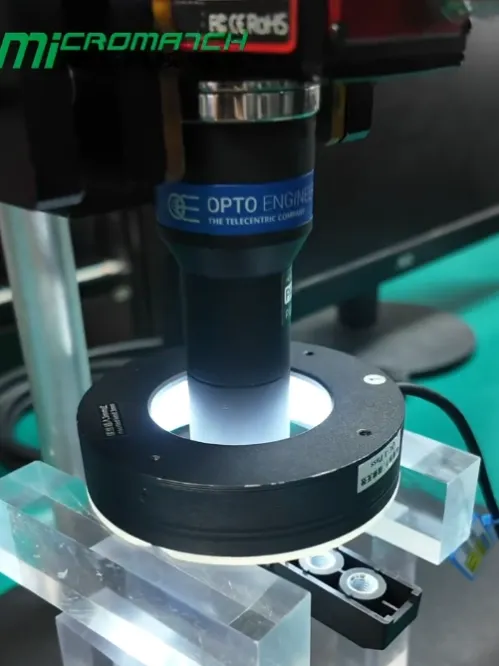
Lighting, lens selection, field of view, working distance, product positioning and image contrast can all affect inspection performance.
AI can improve flexibility, but it cannot reliably inspect a feature that is not visible in the captured image.
For this reason, application testing remains an important part of system selection.
5. When Should You Choose an AI Smart Camera?
An AI smart camera may be a good option when:
- The application requires a compact vision solution
- Inspection criteria include visual variations
- AI-based defect recognition is beneficial
- OCR, classification or presence inspection is required
- Multiple vision tools need to be combined
- The system needs to be integrated into an automated production line
For relatively self-contained inspection stations, a smart camera can also simplify system architecture by combining image acquisition and processing in one device.
6. When Is a Traditional Vision System Better?
Traditional machine vision may be more appropriate when:
- Inspection rules are clearly defined
- Precise geometric measurement is the primary requirement
- Product appearance is highly consistent
- The required feature can be reliably detected using conventional vision tools
- The existing automation system already uses established rule-based inspection methods
The decision should be based on the application rather than assuming that AI is always the better choice.
7. Can AI and Traditional Vision Be Used Together?
Many industrial inspection applications benefit from combining AI and conventional vision tools.
For example, AI can be used to identify complex appearance defects, while traditional tools perform dimensional measurement, positioning or code verification.
A hybrid approach allows each inspection method to be used where it performs best.
This can be particularly useful when a single product requires several different inspection tasks.
8. What Information Is Needed Before Selecting a Camera?
Before selecting an AI smart camera or traditional vision solution, define the application requirements clearly.
Useful information includes:
- Product dimensions
- Inspection features
- Minimum defect size
- OK and NG samples
- Required field of view
- Working distance
- Production speed
- Product movement or positioning
- PLC and communication requirements
- Reject method
Real sample images or physical samples can significantly improve the accuracy of application evaluation.
Choosing the Right Vision Technology
There is no single machine vision technology that is best for every application.
Traditional vision systems remain effective for stable, clearly defined inspection tasks, while AI smart cameras can provide additional flexibility for applications involving appearance variation, classification and complex visual defects.
The best solution depends on what needs to be inspected, how the product is presented to the camera and how the inspection system will be integrated into production.